


The rapid rise of AI has changed more than the technology we use. It is becoming part of how we live, work and create. Agencies are using it, clients are experimenting with it and we are increasingly accustomed to encountering work that has, in some form, been assisted or generated by AI.
The interesting question in 2026 is no longer whether creative agencies should use AI, but where it genuinely adds value, where it begins to diminish it, and what happens to creativity when producing something that looks reasonably good becomes almost effortless.
A recent D&AD report examining the impact of AI on creative agencies makes an important observation: “AI has raised the floor of commercial creativity. Average work is faster, cheaper, easier to polish, and harder to tell apart from everything around it.”
But a distinction between raising the floor and raising the ceiling needs to be drawn. AI is remarkably good at producing something competent, polished and plausible, but competence is not the same as originality, and polish is not the same as creative quality. As competent work becomes easier to produce, the judgement required to recognise genuinely good work becomes more valuable.
Good creative work is built on experience
There is an interesting contradiction at the heart of AI and creativity. The technology can accelerate the creative process, yet much of the expertise required to use it properly comes from having spent years going through that process the slow way.
As the D&AD report puts it, creativity is built through the parts of the process that can appear inefficient: “the first drafts, dead ends, revisions, research, layouts, arguments, failures and repetitions that teach people how to think.”
Those experiences gradually create something that is difficult to quantify but immediately apparent when it is missing: taste. It takes years to develop an instinctive understanding of why one typeface works and another does not, how colour influences perception, how visual hierarchy guides attention, or why a seemingly small change to a website can alter how somebody experiences a brand.
AI can produce countless options almost instantly, but somebody still has to recognise which option is worth pursuing. Without that judgement, the result can be “technically accomplished while still feeling strangely wrong”. It looks professional, the layout works and nothing is obviously broken, yet there is something generic about it that is difficult to ignore.
When everything looks professional, professional is not enough
Generative AI draws upon creative material across the web, identifying patterns and producing new combinations from what it has learned. The results can be impressive, but there is also a danger that brands, websites and campaigns increasingly begin to look alike.
There is a strange circularity to this. AI learns from huge quantities of existing work online, while an increasing proportion of what appears online is itself being created with AI. The result risks becoming a creative ouroboros in which automated design consumes the influence of other automated design, becoming increasingly polished while simultaneously becoming less distinctive.
For businesses, that matters because the purpose of branding and design is not simply to look professional. It is to be recognised, remembered and chosen. If every business has access to tools capable of producing something respectable in seconds, merely producing respectable work stops being a competitive advantage.
Customers appear to be noticing too. According to the report, Klaviyo’s 2026 consumer research found that when people can clearly recognise AI generated content in a brand’s marketing, 32 per cent say they trust that brand less, compared with just 7 per cent who say they trust it more.
The missing ingredient is strategy
Good design has never simply been about making things look attractive. It begins with understanding what a business is trying to achieve, who it needs to communicate with and why anybody should care.
Before we design a website or brand identity, we need to understand what makes the business different, how customers perceive it, where it wants to go and how that identity should translate across different platforms. Getting to those answers requires human conversations, questioning and often challenging what was written in the original brief.
Tools such as ChatGPT, Gemini and Claude are highly capable when given strong inputs. What they cannot independently know is which questions have not yet been asked, or recognise that what a client initially asks for is not necessarily what the business actually needs.
Without creative or strategic direction behind it, AI will produce something perfectly acceptable and completely forgettable.
How Studio Illicit uses AI
Our approach is relatively simple: we use AI underneath the thinking rather than in place of it.
Design
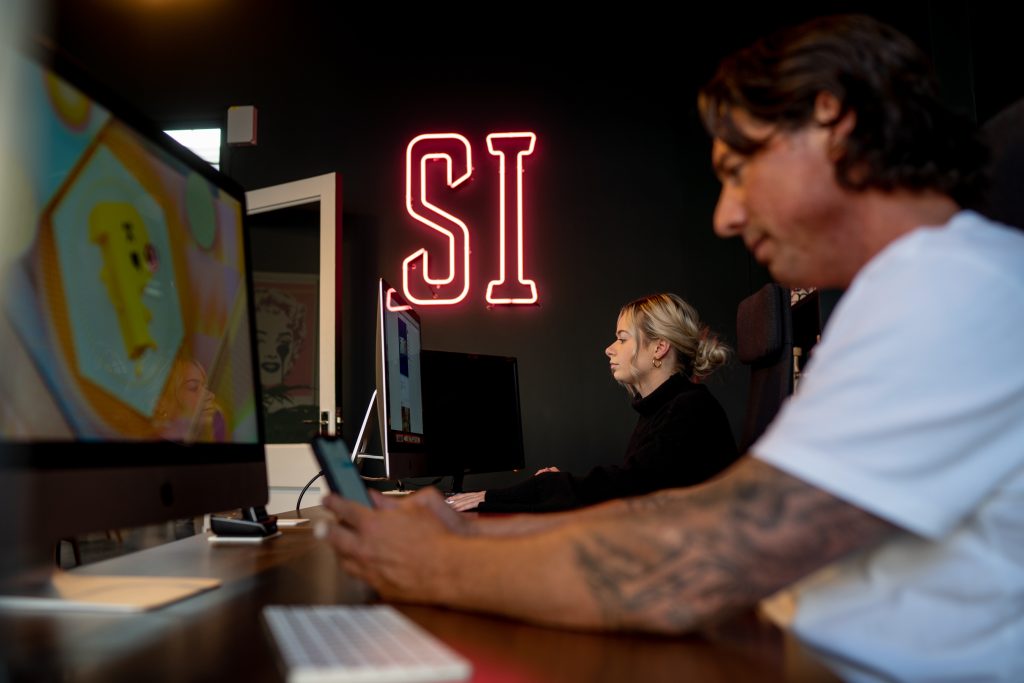
For our creatives, it is particularly useful for prototyping and ideation. We can quickly visualise how a brand identity might look on the side of a van, how this could translate onto packaging, or how different palettes and typography might work in context. It can help us produce placeholder imagery, improve poor quality source photography and explore early layouts before the detailed design work begins. And only where it adds value, specialist agents can support research and exploration in web design.
The important point is that these tools are being directed by designers who already understand what they are trying to achieve. Generating fifty options in seconds has very little value if you cannot recognise which one is right for the client, which needs developing and which forty eight should never leave the screen.
Development
Our developers use AI differently. It can collate, structure and clean data, assist with troubleshooting and help identify potential solutions to technical problems much faster. Development has always involved research and problem solving, and solving an obscure issue once meant poring through technical forums, documentation and years old discussions hoping to find somebody who had encountered the same problem. AI can accelerate that process considerably, without replacing the expertise required to understand, test and implement the solution properly.
Admin
We also use it behind the scenes for administrative automation, note taking, organising information, workflow efficiency and pipeline visualisation. These applications may be less exciting than asking AI to create an entire brand or website, but that is precisely why we find them valuable. They remove friction without attempting to replace the core expertise behind our work.
The real value is judgement
Ultimately, clients are not paying a creative agency simply for the physical production of a logo, website or campaign. They are investing in the expertise behind it: the ability to ask the right questions, challenge assumptions, recognise what is not working and understand how individual creative decisions influence whether somebody notices a business, trusts it and eventually becomes a customer.
That is why we use AI to make parts of our process faster, but not to replace the creative and strategic thinking behind the work. Every colour, typographical decision, layout and call to action should be there for a reason, informed by the audience, the brand and the commercial objective rather than simply assembled because it looks passable.
Essentially, AI cannot remove the need for experience, taste and judgement. In a world where almost anybody can generate something that looks good enough, knowing what is genuinely worth making becomes more valuable than ever.
If this sounds like the kind of thinking you want behind your next project, please get in touch and let’s talk about what’s worth making.